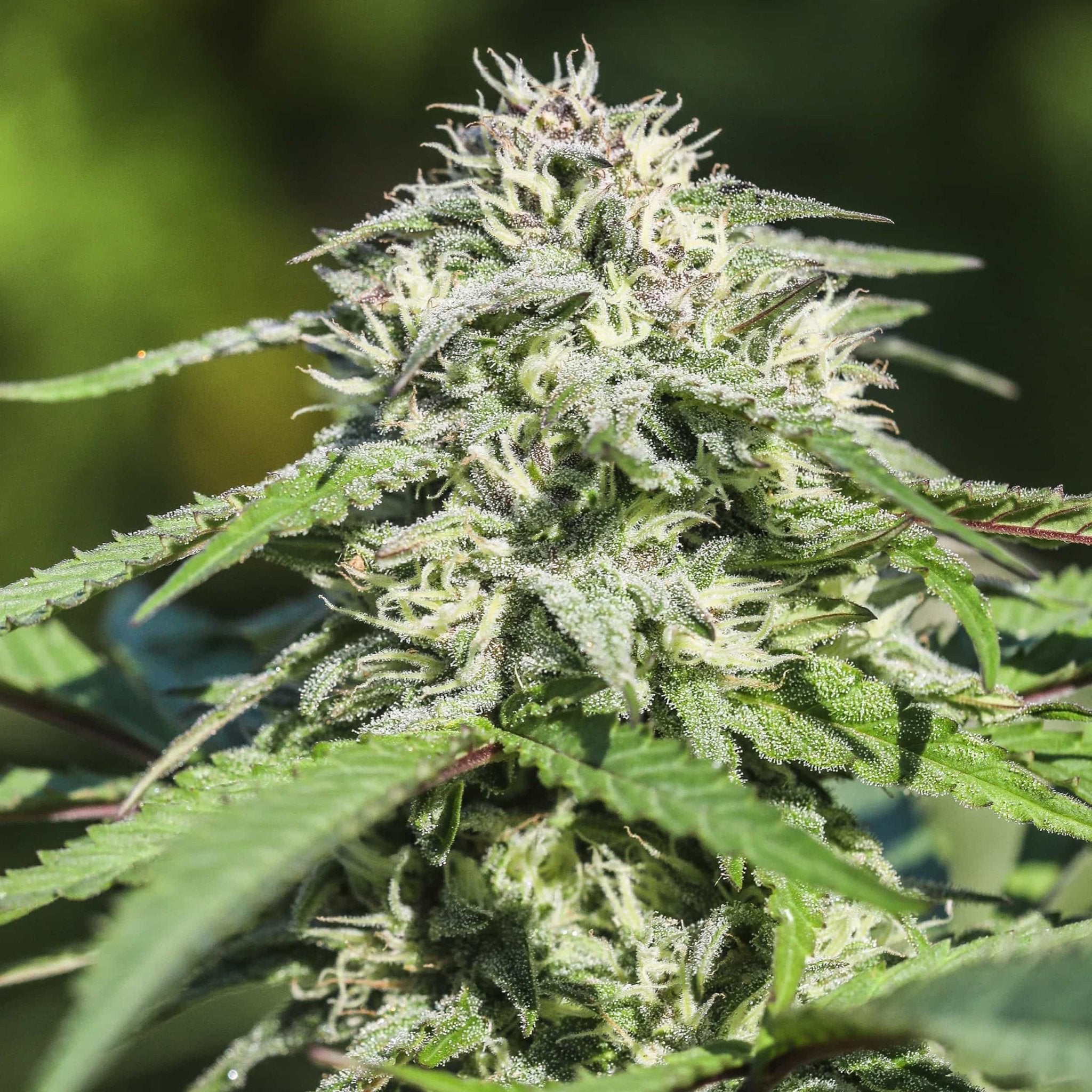


For decades, the cannabis industry has focused almost entirely on two cannabinoids: THC and CBD. But anyone who has spent much time studying cannabis chemistry knows there's a whole lot more going on inside this plant.
Researchers have identified well over 100 naturally occurring cannabinoids, with some scientific reviews documenting more than 180 individual compounds. And there's good reason to believe we haven't found them all.
At GTR Seeds and Oregon CBD, discovering and breeding new cannabinoid profiles has been one of our greatest passions for years.
Sometimes, that pursuit begins with something as simple as an unexpected little blip on a chromatogram.
What Are Cannabinoids?
Cannabinoids are a diverse group of chemical compounds found in cannabis. The plant produces them primarily in glandular trichomes, the resin-producing structures covering cannabis flowers.
Most cannabinoid biosynthesis begins with precursor compounds that eventually form cannabigerolic acid (CBGA), which can then be converted into THCA, CBDA, CBCA, and other related compounds.
While THC and CBD receive most of the attention, cannabis produces numerous other cannabinoids, including THCV, CBDV, CBG, CBGV, CBC, CBN, and many more.
Some are produced directly through specialized enzymes. Others are formed through secondary chemical reactions, oxidation, or degradation.
And many occur in such tiny concentrations that they can be difficult to identify without sophisticated laboratory equipment.
The Known Cannabinoids in Cannabis
Cannabinoids are commonly divided into 11 structural families. Each family contains multiple related compounds, including different side-chain lengths, acidic precursors, and other chemical variations.
Below is an overview of the recognized cannabinoid families and many of their best-known members.
1. THC Family — Tetrahydrocannabinols
The THC family contains some of the most extensively studied cannabinoids in cannabis.
-
Delta-9 THC (Δ9-THC): The primary intoxicating cannabinoid.
-
THCA: The acidic precursor to delta-9 THC, abundant in fresh cannabis flowers.
-
Delta-8 THC (Δ8-THC): A naturally occurring THC isomer generally present in very small amounts.
-
THCV: Tetrahydrocannabivarin, a cannabinoid with a shorter, three-carbon side chain.
-
THCVA: The acidic precursor to THCV.
-
THCB: Tetrahydrocannabutol, a four-carbon THC homologue.
-
THCP: Tetrahydrocannabiphorol, a seven-carbon THC homologue.
-
THC-C1 (THCO): A shorter-chain THC homologue, also called tetrahydrocannabiorcol.
THCV is of particular interest to us at GTR Seeds. Through years of breeding, we've developed varieties capable of producing substantial concentrations of this unusual cannabinoid.
Our Double Durban THCV genetics are an example of how a once-obscure cannabinoid can become the focus of a dedicated breeding program.
2. CBD Family — Cannabidiols
CBD is one of the most widely studied non-intoxicating cannabinoids, but the CBD family includes several related compounds.
-
CBD: Cannabidiol.
-
CBDA: Cannabidiolic acid, the primary precursor to CBD.
-
CBDV: Cannabidivarin, the three-carbon homologue of CBD.
-
CBDVA: The acidic precursor to CBDV.
-
CBDP: Cannabidiphorol, a seven-carbon CBD homologue.
-
CBD-C4: A four-carbon CBD homologue.
-
CBD-C1 (CBDO): Cannabidiorcol, a one-carbon CBD homologue.
-
CBDM: Cannabidiol monomethyl ether.
CBDV has been a particular focus of our breeding work. Like THCV, it demonstrates how variations in cannabinoid side-chain length can create entirely different compounds.
Explore our CBD seeds to learn more about our CBD-dominant genetics.
3. CBG Family — Cannabigerols
CBG is especially interesting because its acidic precursor, CBGA, plays a central role in cannabinoid biosynthesis.
-
CBG: Cannabigerol.
-
CBGA: Cannabigerolic acid.
-
CBGV: Cannabigerovarin, the three-carbon homologue of CBG.
-
CBGVA: Cannabigerovarinic acid.
-
CBGM: Cannabigerol monomethyl ether.
-
CBGB: Cannabigerobutol, a four-carbon homologue.
At GTR Seeds, we've spent years developing CBG-dominant genetics, including varieties producing substantial concentrations of CBGV.
These compounds are particularly exciting because they demonstrate that cannabinoid diversity isn't limited to THC and CBD.
Our CBG seeds are the result of extensive breeding and selection for these unusual cannabinoid profiles.
4. CBC Family — Cannabichromenes
CBC is another naturally occurring cannabinoid with a dedicated biosynthetic pathway.
-
CBC: Cannabichromene.
-
CBCA: Cannabichromenic acid.
-
CBCV: Cannabichromevarin.
-
CBCVA: Cannabichromevarinic acid.
-
CBC-C1: A shorter-chain cannabichromene homologue.
Interestingly, CBC is often present in CBD-dominant cannabis.
Across our high-CBD genetics, we've observed CBC concentrations reaching approximately 1–2% in some plants, even though those varieties weren't specifically bred for CBC production.
Research has demonstrated that CBDA synthase can produce small amounts of CBCA as a secondary reaction, which may help explain this relationship.
5. CBN Family — Cannabinols
CBN is quite different from most cannabinoids because it primarily forms through the degradation of THC and THCA.
-
CBN: Cannabinol.
-
CBNA: Cannabinolic acid.
-
CBNV: Cannabivarin, a shorter-chain CBN-related compound.
-
CBN-C1: A one-carbon CBN homologue.
CBN has become popular in sleep-related wellness products, but unlike THC or CBD, there is no known dedicated synthase gene responsible for producing it directly in substantial quantities.
This creates an interesting challenge for breeders interested in developing CBN-rich cannabis genetics.
6. CBL Family — Cannabicyclols
Cannabicyclol compounds can form through chemical transformations of other cannabinoids, particularly CBC-related compounds.
-
CBL: Cannabicyclol.
-
CBLA: Cannabicyclolic acid.
-
CBLV: Cannabicyclovarin.
These compounds are generally found in small concentrations and remain relatively poorly studied.
7. CBE Family — Cannabielsoins
The cannabielsoin family includes compounds related to the transformation and oxidation of CBD.
-
CBE: Cannabielsoin.
-
CBEA: Cannabielsoic acid.
-
CBE-related isomers: Structurally related compounds reported in cannabis research.
These cannabinoids are another example of how cannabis chemistry continues beyond the plant's primary biosynthetic pathways.
8. CBT Family — Cannabitriols
Cannabitriol and related compounds are generally present in trace concentrations.
-
CBT: Cannabitriol.
-
CBTV: Cannabitriolvarin.
-
Other CBT isomers and derivatives.
Very little is known about the biological activity of most members of this family.
9. CBND Family — Cannabinodiols
Cannabinodiol is a relatively obscure cannabinoid associated with transformations of other cannabinoid structures.
-
CBND: Cannabinodiol.
-
Related cannabinodiol derivatives and isomers.
Like several other minor cannabinoid families, CBND remains poorly characterized.
10. Delta-8 THC Family
Although closely related to delta-9 THC, delta-8 THC compounds are commonly classified as their own structural family.
-
Delta-8 THC: An intoxicating THC isomer.
-
Delta-8 THCA: Its corresponding acidic form.
-
Related delta-8 homologues and derivatives.
Delta-8 THC can occur naturally in cannabis in trace amounts, although concentrated commercial delta-8 products are commonly manufactured through chemical conversion.
11. Miscellaneous and Rare Cannabinoids
Not every cannabinoid fits neatly into the major structural families.
Researchers have also identified compounds such as:
-
Cannabifuran (CBF)
-
Cannabicitran (CBT-C)
-
Cannabiripsol (CBR)
-
Cannabimovone (CBM)
-
Cannabioxepane-related compounds
-
Other rare cannabinoid isomers, homologues, and oxidation products
Many of these compounds have been isolated in extremely small quantities, and their biological properties remain largely unknown.
The full scientific inventory is considerably longer than this overview. Researchers continue to identify additional cannabinoid structures, and the classification of some rare compounds varies between publications.
For a more comprehensive scientific discussion, see The Biosynthesis of the Cannabinoids and In the Weeds: A Comprehensive Review of Cannabis, Its Chemical Complexity, Biosynthesis, and Healing Abilities.
The Next Blip on a Chromatogram
One of the most exciting parts of cannabis breeding is that you never really know what you're going to find.
When we send plant samples to a laboratory for cannabinoid testing, the results are generated using sophisticated analytical instruments that separate and measure chemical compounds.
A chromatogram displays signals, often appearing as peaks, associated with compounds detected during the analysis.
Most growers are primarily interested in the familiar numbers: THC, CBD, maybe CBG.
But we're often interested in something else entirely.
What's that little blip on the chromatogram that doesn't look like everything else?
Could it be an unusual cannabinoid? A rare side-chain variant? An unexpected ratio of compounds? Or something we haven't encountered before?
Of course, an unusual peak isn't automatically a new cannabinoid. It could be a known compound, a contaminant, or an analytical artifact. Proper identification requires additional testing, often involving reference standards and more advanced analytical methods.
But sometimes those unexpected signals are exactly where interesting discoveries begin.
From an Unusual Lab Result to a New Cannabis Variety
At GTR Seeds and Oregon CBD, our breeding programs have long focused on finding unusual cannabinoid profiles and determining whether we can reliably reproduce them through genetics.
Discovering an interesting plant is only the beginning.
First, we need to understand what we're looking at. Is the compound actually present? Can it be reliably quantified? Is it a known cannabinoid appearing at an unusual concentration, or something less familiar?
Then comes the real challenge.
Can we breed it?
A single plant with an unusual cannabinoid profile doesn't necessarily mean the trait can be consistently inherited.
Developing a reliable seed variety requires multiple generations of selection, genetic analysis, testing, and field evaluation.
We need plants that don't just produce an interesting cannabinoid once, but consistently express the desired trait while maintaining favorable agronomic characteristics.
That's where the work really begins.
THCV, CBDV, and CBGV: Examples of What's Possible
Some of the cannabinoids we've pursued were once little more than obscure entries in scientific literature.
THCV, CBDV, and CBGV are excellent examples.
These cannabinoids belong to a group commonly called varins, which have shorter, three-carbon side chains than their more familiar five-carbon counterparts.
That relatively small chemical difference creates distinct cannabinoids with potentially different biological properties.
Through years of breeding and selection, we've worked to develop genetics that produce these compounds at concentrations far beyond the trace levels commonly found in cannabis.
Our work with THCV, CBDV, and CBGV demonstrates why we're so interested in exploring unusual cannabinoid profiles.
What starts as a small analytical signal can eventually become the foundation of an entirely new breeding direction.
And there's no reason to believe we've reached the end of what's possible.
What Cannabis Genomics Is Teaching Us
In 2025, GTR Seeds and Oregon CBD contributed to a major collaborative study published in Nature.
The research, Domesticated cannabinoid synthases amid a wild mosaic cannabis pangenome, examined 193 cannabis genomes and revealed extraordinary genetic diversity across the species.
Among its findings were genetic variants associated with the production of rare cannabinoids, including THCV and CBDV.
The research also revealed substantial variation in genes involved in fatty acid metabolism, which can influence the chemical precursors available for cannabinoid biosynthesis.
This is particularly interesting because cannabinoid diversity isn't determined solely by the familiar THCA and CBDA synthase genes.
Other genetic pathways help determine which precursors are produced, which enzymes can act on them, and ultimately which cannabinoids accumulate.
The more we learn about the cannabis genome, the more opportunities we have to identify and develop unusual cannabinoid profiles.
And the study made something else clear: the genetic diversity of cannabis remains far from fully explored.
Why Discovering New Cannabinoids Matters
Cannabinoids are of growing interest to researchers investigating sleep, inflammation, neurological function, pain, and numerous other biological processes.
However, the vast majority of identified cannabinoids have received very little scientific attention.
Some have barely been studied beyond their chemical structures.
One of the biggest obstacles to researching rare cannabinoids is simply obtaining enough of them.
When a compound naturally occurs at a fraction of a percent, producing sufficient quantities for meaningful research can be difficult and expensive.
This is where plant breeding can play an important role.
If breeders can develop plants that reliably produce higher concentrations of rare cannabinoids, researchers may gain more practical access to these compounds.
That doesn't mean every cannabinoid will turn out to have important medical applications. Some may offer little therapeutic value, and others may present safety concerns that haven't yet been identified.
But we won't know without research.
Our goal is to help make these compounds more accessible for legitimate scientific investigation and, where their safety, benefits, and legal status are established, eventual use by patients and consumers.
The Search Is Far From Over
We've been breeding cannabis for a long time, and one thing we've learned is that this plant still has plenty of surprises.
There are hundreds of possible chemical variations, complex interactions between biosynthetic pathways, and an enormous amount of genetic diversity that remains unexplored.
Some of the most interesting cannabinoids of the future may already exist in plants growing somewhere today, waiting for someone to recognize them.
At GTR Seeds and Oregon CBD, we're going to keep looking.
We'll keep testing, selecting, crossing, and chasing unusual cannabinoid profiles wherever the science takes us.
Because sometimes the next great discovery doesn't begin with a grand scientific breakthrough.
Sometimes it starts with a tiny blip on a chromatogram that makes us say, "What the hell is that?"
And that's when things get interesting.